

Sloped Yard Preparation for In-Ground Trampolines
September 26, 2026
AkrobatUSA Trampolines Versus Competitors: Which Wins?
September 30, 2026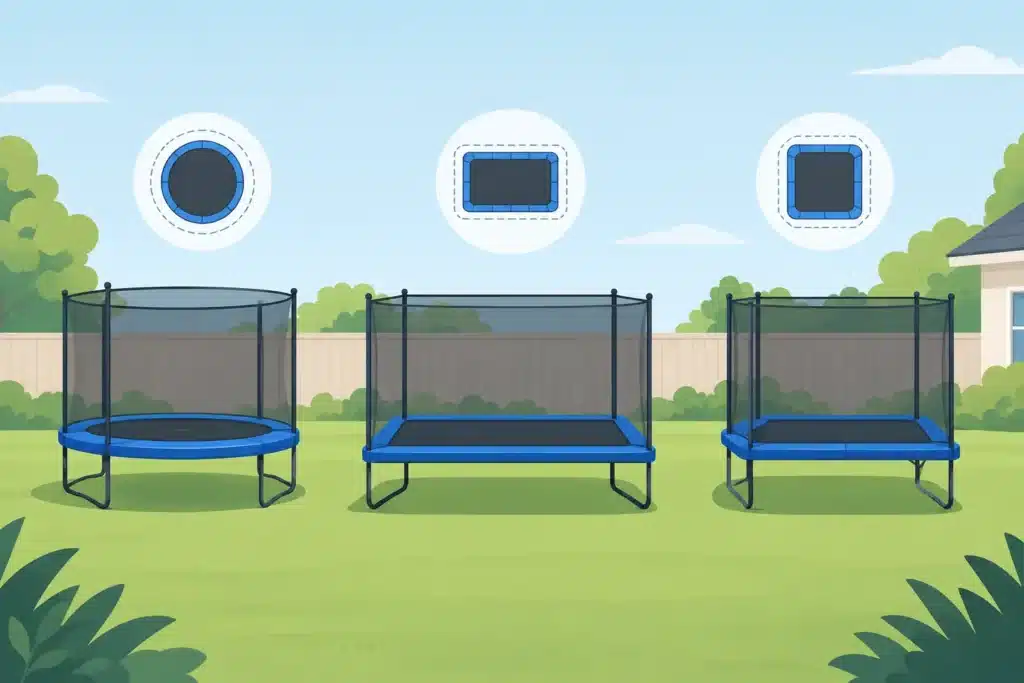
A backyard does not need to be huge to become the place where your kids want to play after school. The question is which trampoline shape saves space without making the yard feel crowded, limiting safe access, or sacrificing the jumping experience your family wants. For most compact or narrow yards, a rectangular in-ground trampoline is the most space-efficient choice. But a round trampoline can still be the better fit when your usable area is more open and your priority is flexible family play.
Which trampoline shape saves space most effectively?
Rectangular trampolines usually save the most usable yard space because their straight sides can sit parallel to a fence, patio, garden border, or property line. Instead of leaving awkward curved pockets of lawn around the frame, a rectangle makes clean use of the space you already have.
That is why an in-ground rectangle such as a 10-foot by 6-foot or 11-foot by 8-foot model can be an especially smart choice for a side yard, a long narrow lawn, or a backyard with a pool, playset, outdoor kitchen, or established landscaping. It creates a dedicated activity zone while preserving room for everything else that makes your backyard work for your family.
A round trampoline needs a square-like area around its circular footprint. A 10-foot round model may sound compact, but the yard space needed for safe access and an enclosure extends beyond the diameter. In an open backyard, that may be easy to accommodate. Along a fence or beside a patio, however, the curved outline can make placement less efficient.
Why rectangular trampolines fit tight yards better
The practical advantage of a rectangle is not just its shape on paper. It is how easily it fits into the lines that already define a residential yard. Most patios, fences, homes, retaining walls, and garden beds are straight. A rectangular trampoline follows those lines, helping the installation look intentional rather than squeezed in.
A better choice for long or narrow spaces
If your yard has depth but limited width, a rectangular model gives you options that a round model cannot. A 10-foot by 6-foot trampoline can be positioned lengthwise along a side yard or set beside a patio with a more predictable footprint. You can keep a clear route from the house to the gate, protect a favorite planting bed, and still give children a premium place to jump.
This is particularly valuable for homeowners planning an in-ground installation. Once excavation is complete, the trampoline becomes a lasting part of the landscape. Choosing a shape that works with the yard’s natural layout helps the finished space feel polished for years, not merely workable on installation day.
Less wasted lawn around the perimeter
With a round trampoline, the corners of the surrounding square layout may be hard to use. You may not be able to mow them comfortably, place furniture there, or use them as a walkway. Rectangular designs reduce that unused space because their edges align with the boundaries around them.
That does not mean a rectangular trampoline always takes less total area. An 11-foot by 8-foot rectangle has a larger jumping surface than a 10-foot round model. The space-saving benefit comes from placement efficiency, not from assuming every rectangle is smaller. Compare the full installed dimensions of the exact models you are considering before making a decision.
When a round trampoline is the smarter use of space
Round trampolines remain a favorite for good reason. In a more open, square, or centrally located section of the yard, a round 10-foot, 12-foot, or 14-foot in-ground trampoline can look beautifully balanced. The curved shape feels natural in a lawn setting and gives younger children a welcoming, shared place to play.
A round model is also a strong fit when the trampoline will be the main recreation feature in the yard. If you have room to place it away from walls, trees, hardscape, and property boundaries, you do not need to force a rectangular shape simply to save a few feet. The best installation is one that leaves adequate safety space and lets children enter, exit, and play comfortably.
For families with several children, a larger round trampoline may be the better everyday choice if the yard supports it. It provides a generous, central play area and can make the entire backyard feel like a destination for active outdoor fun.
Measure the installed footprint, not only the jumping area
The most common planning mistake is measuring only the trampoline’s stated size. The jump mat dimensions are only one part of the decision. Whether you choose round or rectangular, plan for the complete system and the area around it.
Start by mapping the location of fences, patios, pool edges, trees, sheds, utility equipment, gardens, and irrigation lines. Then account for the safety enclosure, entry point, retaining wall or installation components, and room for adults to supervise. An in-ground trampoline has a low-profile look, but it still requires thoughtful clearance around the perimeter.
Avoid placing any trampoline directly beside hard surfaces, sharp landscape edges, or low tree limbs. Check the specific product instructions for required clearance, and confirm that your excavation plan accounts for drainage and soil conditions. A premium trampoline deserves an installation that supports long-term performance as well as safer play.
Put access on the plan early
Think about how children will reach the trampoline. A rectangular model beside a patio may save lawn space, but its entry should not open into a crowded path or a row of outdoor chairs. Likewise, a round model placed in the middle of the yard should not interrupt the route to the garage, pool, or back gate.
Mark the proposed footprint with garden hoses, string, or marking paint before you buy. Stand at the kitchen window, walk through the yard, and picture a busy Saturday with kids jumping, adults grilling, and guests moving around the space. This simple step often makes the right shape obvious.
Choose for your family’s jumping style, too
Space matters, but so does how your family will use the trampoline. Rectangular trampolines provide a longer, more directional jump path that active older children, teens, and adults often enjoy. They are a natural match for families who want a focused exercise and skill-building space in a compact yard.
Round trampolines guide jumpers toward the center and create a familiar all-purpose play area. For younger children and casual family use, that can be exactly what you want. A round shape may not be the most efficient beside a fence, but it can be the most enjoyable choice for the people who will use it every day.
Keep single-jumper-at-a-time guidelines in place regardless of shape. A quality safety enclosure, adult supervision, and clear household rules are just as important as selecting the right footprint. Strong galvanized, rust-resistant materials and a well-designed in-ground system help protect your investment through changing seasons and years of active use.
Make the shape work with your landscape
An in-ground trampoline should add to the backyard, not dominate it. Rectangular systems tend to complement modern patios, linear garden designs, and narrow lots. Round systems soften an open lawn and can create a natural focal point in a more traditional backyard setting.
At Lets Buy Trampolines, families can choose premium in-ground sizes that suit both compact spaces and bigger backyard plans. The right model is the one that gives your children room to move, preserves practical yard space, and fits the landscape you want to enjoy together.
Before you commit, lay out the full installation area and give safety clearance the same priority as the trampoline size. A rectangle is usually the space-saving winner, but the best choice is the one that leaves your family with a safer, more useful backyard ready for years of outdoor memories.