

10 Foot In-Ground Trampoline: Is It Right?
August 7, 2026
Springless Versus Spring Trampoline: Which Wins?
August 11, 2026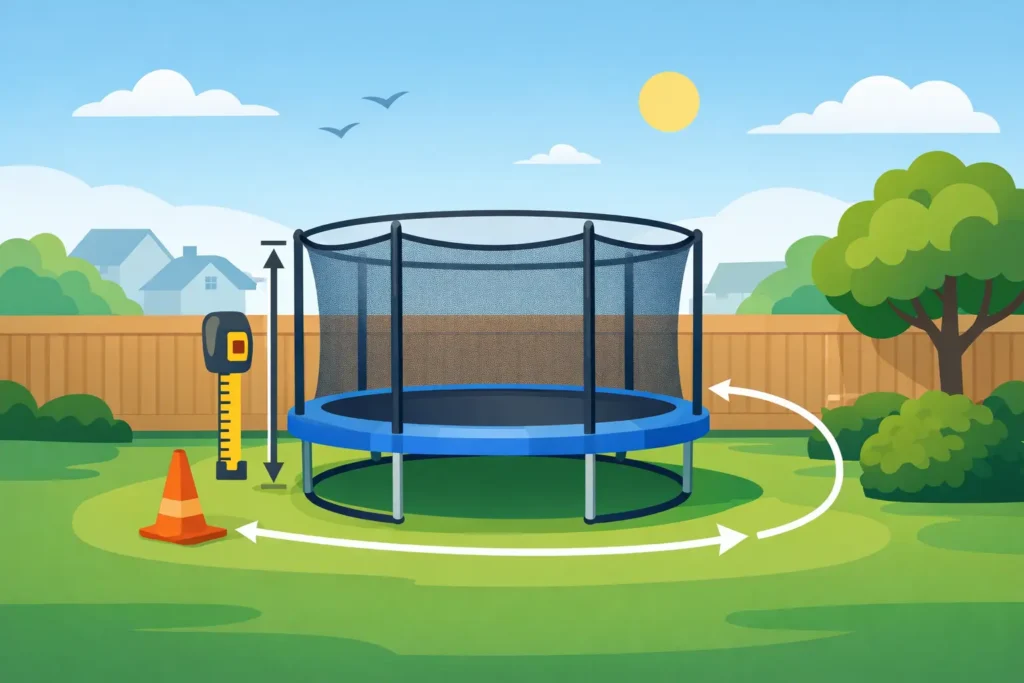
A beautiful in-ground trampoline can look like it belongs in your landscape from day one. But that low-profile finish only works when the space around it is planned with the same care as the trampoline itself. Proper trampoline clearance measurement protects jumpers, preserves the safety system’s performance, and helps you avoid placing a major backyard investment where a tree, fence, slope, or utility line creates a problem later.
For most families, this is not a matter of finding an empty patch of grass and matching it to a frame diameter. You need to measure the full activity zone – above the trampoline, around its perimeter, and below ground – before choosing a size or scheduling excavation.
What trampoline clearance measurement really includes
Clearance is the open, usable space that lets a trampoline function safely. With an in-ground system, the jumping surface is closer to the lawn, which creates a clean backyard look and makes entry easier for kids. It does not mean the trampoline needs less thoughtful planning.
Start by viewing the project in three dimensions. Overhead clearance accounts for branches, rooflines, lights, power lines, and other objects above the jumping area. Perimeter clearance is the open ground around the trampoline and its enclosure. Underground clearance covers the excavation pit, drainage plan, soil conditions, roots, irrigation, and buried utilities.
The exact dimensions should always follow the installation manual for the trampoline and safety enclosure you select. A premium round 10-foot, 12-foot, or 14-foot model does not share the same footprint, pit dimensions, or surrounding space needs. Rectangular systems also require their own layout calculations because their corners and longer sides change how they fit into a yard.
Measure the complete installed footprint, not only the mat
A common planning mistake is measuring the jump mat or quoted trampoline size and treating that number as the required yard space. The frame is larger than the mat, and the safety enclosure extends beyond the frame in some designs. Access points, retaining edges, drainage routes, and a comfortable walking area may add more room.
Use the manufacturer’s dimensions for the exact model, then mark the complete installed footprint on the lawn. Landscape marking paint, stakes, and string work well for a first look. For a round trampoline, mark the center point and create the full circle. For a rectangle, square the corners carefully so you see the true orientation rather than a rough outline.
Then walk the perimeter as a family. Can an adult move around the system to inspect the enclosure, clear leaves, fit a weather cover, or supervise children? Is there a natural path from the patio or back door? Does the planned location leave room for mowing and landscaping without forcing you into a tight passage beside a fence?
This simple step often answers a key sizing question. A 14-foot round trampoline may be ideal for a busy household with older kids, but a 12-foot model can be the smarter long-term choice if it leaves a more generous safe zone and keeps the rest of the backyard usable.
Plan open space around the enclosure
The area immediately outside the trampoline should remain clear of hardscape edges, fences, swing sets, grills, patio furniture, garden walls, and play equipment. Avoid putting the enclosure directly beside a hedge or dense planting, too. It may look soft, but it can crowd access, trap debris, and make routine inspections difficult.
Use the clearance specification supplied for your model as the minimum, then add practical room whenever your yard allows it. A yard with a wide lawn and a centered in-ground trampoline is easier to supervise and easier to maintain than one where the enclosure is squeezed into a corner.
Slopes deserve special attention. A slight grade can often be managed through excavation and landscape finishing, but the finished trampoline should not send rainwater toward the pit or leave one side awkwardly close to a retaining wall. A professional site review is especially worthwhile on uneven ground.
Check overhead clearance before choosing a location
Look up before you fall in love with a spot. Children gain height quickly when they jump, and an enclosure is not permission to install beneath a low branch or roof overhang. Overhead obstacles can limit safe use and may damage the net, frame, or nearby property during wind and storms.
Begin at the planned center of the trampoline and inspect the whole area above it, including the outer enclosure zone. Consider branches that move in the wind and trees that will grow over the next several years. A location that appears open in winter can be very different once leaves return.
Never place a trampoline beneath or near overhead power lines. If utility lines cross the area, choose another location and contact the utility provider if you have any uncertainty. Outdoor lighting, basketball hoops, clotheslines, and roof eaves also belong in your measurement check.
A clear sky above the trampoline makes the backyard feel more open, gives jumpers room to play with confidence, and reduces the need for constant trimming or adjustments. It is one of the easiest safety advantages to build into the project before installation begins.
Account for the excavation below the lawn
An in-ground trampoline is a landscape project as much as a recreation purchase. The pit needs to match the manufacturer’s required shape and depth so the trampoline performs as designed. If the excavation is too shallow, the jumping bed may contact the ground below. If the walls, drainage, or ventilation are handled poorly, water and soil pressure can create avoidable issues.
Your below-ground measurement should account for more than the opening you see at lawn level. Confirm the required excavation profile, including any sloped or stepped walls specified by the manufacturer. Plan where excavated soil will go and how equipment will reach the site without damaging irrigation, landscaping, or existing hardscape.
Drainage is essential. Water should not collect under the trampoline after a heavy rain. Depending on soil type, local rainfall, and the site’s natural grade, your installation may need a drainage layer, drain route, or other approved solution. Clay-heavy soil and low-lying yards usually require more careful planning than a well-drained, level lawn.
Call 811 before digging to have public utility lines marked, and identify private lines as well. Irrigation pipes, landscape lighting wires, invisible pet fencing, pool equipment lines, and septic components may not be included in standard utility markings. Keep the installation away from those systems unless a qualified professional confirms a safe plan.
Tree roots matter, too. Large mature trees can complicate excavation, affect drainage, and make future root growth a concern. Cutting major roots can harm a valuable tree and may not solve the long-term problem. If the only available location is near a large tree, have the site evaluated before committing to a trampoline size.
Match the trampoline size to the yard and your family
The best size is not automatically the largest model that can physically fit. It is the size that gives your family enough jumping room while preserving the clearances, access, and backyard layout that make the system enjoyable every day.
A round 10-foot in-ground trampoline can be an excellent fit for younger children, smaller lawns, or families who want a dedicated play feature without giving up the entire yard. A 12-foot round model often provides a comfortable balance of usable jump space and site flexibility. A 14-foot round model gives active families more room, especially as children grow, but it needs a larger open area and a larger excavation plan.
Rectangular models can be a strong choice for narrow or intentionally designed spaces. A 10-foot by 6-foot or 11-foot by 8-foot trampoline may align naturally along a lawn edge or landscape axis where a round model feels oversized. Still, do not assume a rectangle is automatically easier to place. Its corners, enclosure layout, and clearance requirements need to be measured precisely.
Think about who will use it most. One child learning basic jumps has different needs from teenagers practicing athletic movement or an active family using the trampoline for regular exercise. Safe use should follow the product instructions, including limits on the number of jumpers. More space is valuable, but it never replaces active supervision and clear family rules.
A practical way to check your site
Before ordering, take a tape measure, a few stakes, and your selected model’s installation dimensions outside. Mark the trampoline footprint, then mark the recommended surrounding clearance zone. Check the area from ground level and from windows, the patio, and the house entrance where adults will supervise.
As you review the layout, ask whether the site stays clear through every season. Consider falling leaves, snow storage, pool traffic, garden growth, outdoor furniture, and the path a contractor will need for excavation. Also check local permit requirements, property setbacks, neighborhood rules, and any drainage restrictions that apply to your home.
At Lets Buy Trampolines, we encourage families to treat site measurements as part of choosing the right premium in-ground system, not as an afterthought. The right model, installed with proper clearance, gives you a safer place for movement, laughter, and the kind of outdoor time that keeps calling everyone back outside.
Take a few extra minutes with the tape measure before you buy. A well-planned location gives your family more than a trampoline – it gives you a backyard feature you can enjoy with confidence for years.