

7 In-Ground Trampoline Benefits for Families
September 6, 2026
Trampoline Weather Protection for Every Season
September 10, 2026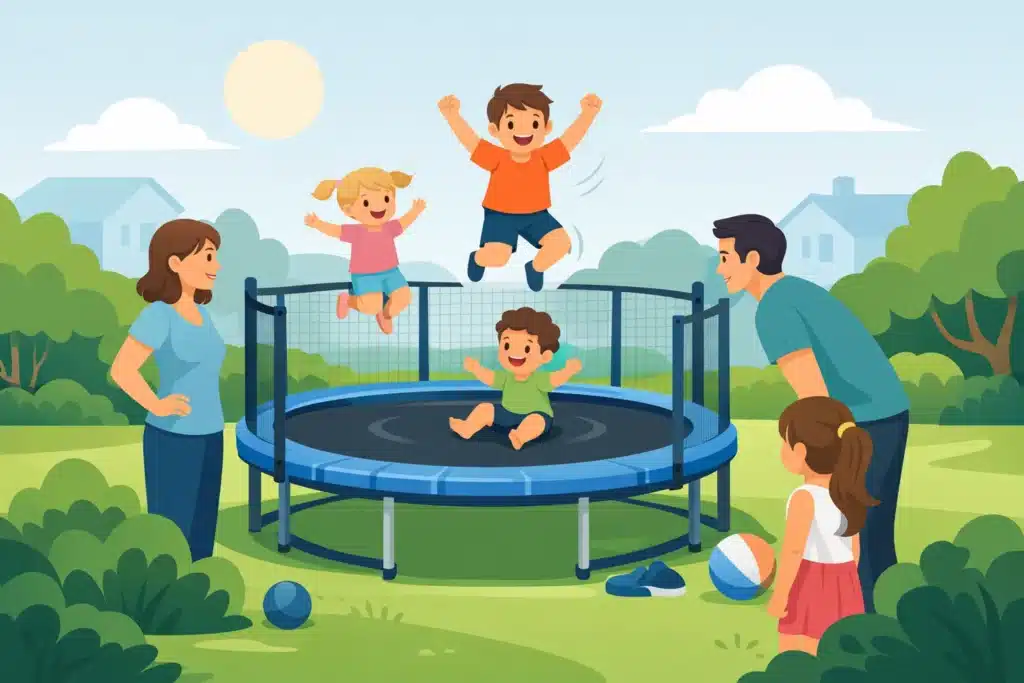
A backyard trampoline can become the place where kids burn off after-school energy, teenagers practice coordination, and the whole family spends more time outside. But a trampoline is not a one-size-fits-all purchase. This trampoline age suitability guide helps parents match the right in-ground system, safety setup, and house rules to the people who will actually use it.
Age matters because a preschooler, an eight-year-old, and a teenager use a trampoline very differently. The goal is not simply to buy the biggest model your yard can hold. It is to create a dedicated play and exercise space with enough room, the right protection, and clear expectations that can grow with your family.
Start With the Age-Six Safety Baseline
Most pediatric and trampoline safety guidance recommends that children under six not use a full-size trampoline. Younger children are still developing balance, body awareness, coordination, and bone strength. A bounce that seems small to an older child can be unpredictable for a toddler or preschooler.
That does not mean younger siblings have to be left out of backyard time. It means the full-size family trampoline should be treated as an older-child activity. Use the time to establish a household rule early: no one under six on the trampoline, even when an older child is present to “help.” Older children cannot safely control another jumper’s landing or bounce.
For families with children on both sides of that age line, this is where supervision matters most. Keep the enclosure zipped, remove ladder access if your setup includes a ladder, and make sure the youngest children understand that the trampoline is not a climbing structure. An in-ground design has a lower profile than a raised trampoline, but it still needs the same thoughtful boundaries.
Ages 6 to 9: Build Confidence, Not Big Tricks
Once children reach six, a quality trampoline can support active outdoor play, confidence, and basic movement skills. At this stage, simple controlled bouncing is the priority. Children should practice stopping on command, bouncing in the center, and exiting carefully through the enclosure opening.
A round in-ground trampoline is often an excellent choice for younger school-age children. Its shape naturally guides jumpers toward the center, which helps support more predictable use. A 10-foot round model can work well for a smaller yard or a household with one primary jumper at a time, while a 12-foot round gives growing children more usable space without taking over the landscape.
Parents should resist the temptation to allow sibling jumping because everyone is “being careful.” The safest rule remains one jumper at a time. When two people jump together, the lighter child can be launched higher or land off balance due to the heavier jumper’s rebound. This matters especially for kids ages 6 to 9, whose size and strength can vary dramatically even within the same family.
An enclosure is not an optional finishing touch for this age group. It is a central part of the safety system. Choose durable netting, properly padded frame and spring areas, and a secure entrance that children cannot leave open between turns.
Ages 10 to 12: Choose Space for Growing Skills
Preteens tend to use a trampoline longer and more energetically. They may create games, challenge themselves with fitness routines, or spend extended afternoons outside with friends. Their increased coordination can make trampoline time more rewarding, but it can also lead to bigger bounces and more testing of limits.
For many families, a 12-foot or 14-foot round in-ground trampoline hits the sweet spot during these years. The additional jumping surface gives a growing child more room to land near the center and gives your investment a longer useful life as younger children become teenagers.
A rectangular trampoline can also make sense when your family has a specific reason to choose one. Rectangular formats, such as 10-foot by 6-foot or 11-foot by 8-foot systems, provide a more consistent bounce across the mat and can fit narrow or carefully planned backyard spaces. They are a strong option for active families, but their more responsive feel calls for clear rules and responsible use.
This is a good age to teach the difference between confidence and risk. Children do not need to be discouraged from being active. They need boundaries: no flips without appropriate coaching and experience, no bouncing toward the enclosure, no toys on the mat, and no jumping when the surface is wet, icy, or covered with debris.
Teens Need Room, Rules, and a Durable System
Teenagers may use a trampoline for conditioning, stress relief, friendly competition, or simply a place to get away from screens. They also bring more body weight, greater force, and a stronger desire to try advanced moves. A trampoline that felt spacious at age seven can feel restrictive by the high school years.
If your household includes teens or you are buying once for children who will grow into the system, larger models are usually the smart long-term choice. A 14-foot round trampoline provides generous room for a single jumper, while a larger rectangular layout can suit families who value athletic-style bounce and have the yard footprint for it.
Premium materials become especially meaningful here. Rust-resistant galvanized steel, commercial-grade components, a properly engineered in-ground frame, and a strong enclosure help your system stand up to frequent use and changing weather. A weather cover can also protect the mat and components during periods when the trampoline is not in use, helping preserve the investment your family made.
Teen independence does not replace safety expectations. Parents should continue to enforce one jumper at a time, prohibit horseplay, and set rules around friends. Before guests use the trampoline, explain the family rules instead of assuming they know them. The few seconds it takes can prevent a careless decision from becoming a painful afternoon.
Why In-Ground Designs Work Across Family Stages
An in-ground trampoline can be a particularly smart choice for families planning to use their backyard feature for years. The low-profile look integrates more naturally into a patio, lawn, or landscaped play area. It can also make access easier for age-appropriate users because there is no elevated frame to climb onto.
Still, in-ground does not mean risk-free. The excavation must be planned correctly, including drainage and adequate air movement beneath the mat. The frame, retaining wall system where required, enclosure, and surrounding surface all need to be installed according to the product instructions. A beautifully designed in-ground trampoline deserves a properly prepared site.
Think beyond the trampoline dimensions when measuring the yard. You need open clearance around the unit, room for the enclosure, and a location away from trees, fences, play structures, hardscape edges, and overhead obstructions. A safety-focused layout gives children more room to enter, exit, and play without nearby hazards.
Make Your Purchase Fit the Youngest and Oldest User
The best size decision usually comes down to your oldest likely jumper, your available yard space, and how long you want the trampoline to serve your family. Buying solely for a six-year-old’s current size may leave you wishing for more room within a few years. Buying the largest possible unit without considering your yard’s usable clearance can create installation and safety compromises.
Ask practical questions before deciding: Will one child use it most days, or will several children take turns? Are your kids young now but likely to use it through their teen years? Is the trampoline mainly for casual play, or do you expect frequent fitness and athletic use? Do you have room for a round 12-foot or 14-foot model, or does a compact rectangle fit your backyard plan better?
Lets Buy Trampolines helps families compare premium in-ground options built for lasting backyard use, from compact layouts to larger systems designed for years of active play. The right answer is not always the biggest model. It is the model that gives each age-appropriate user enough room, reliable protection, and a setup your family can maintain with confidence.
Keep the Rules Consistent as Kids Grow
A trampoline safety plan works best when it is simple enough for everyone to remember. Keep it visible and consistent: one jumper at a time, adult supervision for younger users, no flips unless properly trained, no roughhousing, and no use in poor weather or on a damaged trampoline. Inspect the mat, springs or spring system, padding, enclosure, frame, and entry point regularly, especially after storms or heavy seasonal use.
As your children get older, involve them in those checks. Asking a teen to point out a loose connection, worn pad, or open enclosure turns safety from a parent lecture into a shared responsibility. It also reinforces that premium backyard equipment lasts longer when it is treated with care.
The best family trampoline is not defined by an age printed on a box. It is defined by a thoughtful match between your children’s development, your yard, your supervision plan, and a durable safety-focused system that invites them outside year after year.