

Trampoline Shape Comparison for Your Backyard
August 29, 2026
Premium Trampoline Versus Budget Model: Worth It?
September 2, 2026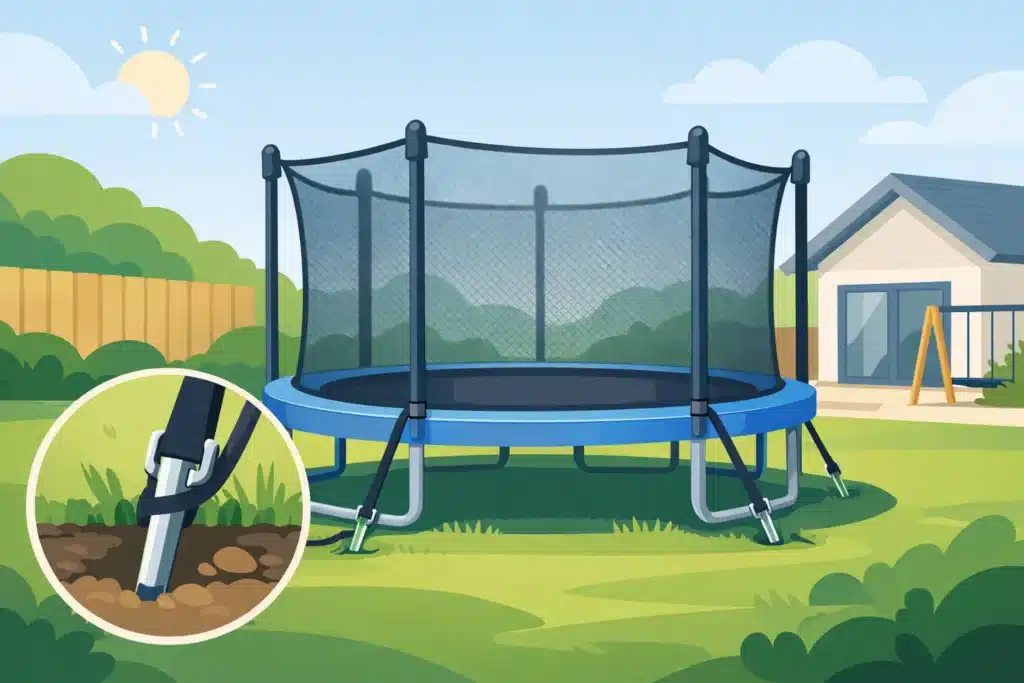
A safety enclosure only works as well as the system holding it in place. Trampoline net anchoring is often used to describe two related jobs: securing the trampoline against wind and keeping the enclosure net correctly attached to its frame and poles. They are not the same task, and treating them as one can leave a family trampoline less secure when it matters most.
For homeowners investing in a premium in-ground trampoline, the goal is simple: create a dependable play space that stays attractive, performs well through changing weather, and gives children clear boundaries while they jump. Proper installation, regular checks, and the right accessories all play a part.
What Trampoline Net Anchoring Really Means
A trampoline safety net is designed to guide jumpers back toward the jumping surface rather than allowing an accidental fall to the ground. The net typically connects to enclosure poles, a top ring or support system, and the trampoline frame through straps, clips, sleeves, or ties specified by the manufacturer. Those connection points are the net’s anchoring system.
Ground anchors serve a different purpose. They help resist wind uplift and unwanted movement by securing the trampoline frame to the ground. On an above-ground model, anchors may be installed through the frame legs or straps. An in-ground trampoline has no traditional exposed legs, but it still needs a properly designed installation, a level frame, and site-specific measures that follow the manufacturer’s instructions.
Do not attach an enclosure net directly to ground anchors, landscaping stakes, a fence, or a tree. A safety net needs to move and flex as designed. Pulling it tight toward the ground can change how it handles a jumper’s impact, strain the poles, and create a poor entry and exit area.
Why a Secure Enclosure Matters for Families
Children do not jump in straight lines. They drift, bounce sideways, and test the limits of the space when friends are over. A properly installed enclosure gives them a visible, flexible boundary that helps contain that normal movement.
The benefit is not only about preventing a fall. A net that is evenly secured stays out of the way of the jumping area, has fewer loose sections for hands or clothing to catch, and allows the entrance to close as intended. When straps are missing, poles lean inward, or the lower edge has gaps, the system is asking more of a child than it should.
Premium trampoline systems use strong, weather-ready materials because backyard equipment lives outside. Even galvanized, rust-resistant steel and commercial-grade netting need seasonal attention. Sun exposure, wind, moisture, lawn equipment, and enthusiastic daily use can gradually affect hardware and fabric.
Ground Anchors and Wind Protection
Wind is one of the most overlooked risks in trampoline ownership. A trampoline can become unstable or airborne during strong gusts, especially when it is not properly installed or when a storm arrives before it has been secured. Ground anchors can be a smart addition for applicable above-ground models, but the correct anchor type depends on the trampoline design, soil conditions, and local weather patterns.
A spiral-style anchor may work well in firm soil, while softer, sandy, rocky, or heavily saturated ground may require a different approach. The anchor itself is only one part of the system. Straps must be rated for outdoor use, positioned according to the manufacturer’s directions, and checked for fraying or sun damage. A loose strap is not a small cosmetic issue when wind loads increase.
For an in-ground trampoline, resist the urge to improvise with anchors after installation. The excavation, retaining structure, drainage plan, and frame support all work together. Adding hardware in the wrong location can interfere with drainage, damage the frame, or compromise the finish around the trampoline. If you are concerned about wind exposure, discuss the site before installation rather than trying to solve it later with a hardware-store shortcut.
Trampoline Net Anchoring Checks Before Jumping
A quick walk-around takes only a few minutes and is one of the best habits a family can build. Before a high-energy afternoon of jumping, look at the entire enclosure rather than focusing only on the mat.
Check that the net is connected at every intended point and that the lower edge does not have a gap large enough for a child to slip through. Confirm that enclosure poles are upright, padded where required, and firmly seated in their mounts. The entrance should zip, overlap, buckle, or close according to its original design. If it does not close reliably, pause play until it is repaired.
Then look for damage that can grow quickly under tension. Small holes, stretched mesh, cracked clips, bent poles, torn straps, and exposed sharp edges are all reasons to stop using the trampoline until the affected part is replaced. Do not tie a torn net together with rope, wire, bungee cords, or zip ties as a long-term repair. Those fixes can create hard contact points and do not restore the enclosure’s intended performance.
Keep the jump zone simple
Only one jumper should use the trampoline at a time, even when the enclosure is in excellent condition. The net is a boundary, not a substitute for safe jumping rules. Keep shoes, balls, toys, and furniture off the jumping surface, and make sure children understand that flipping and rough play increase the chance of injury.
Adult supervision matters most when younger children are using the trampoline or when guests are unfamiliar with the family’s rules. A well-maintained safety system gives parents more confidence, but it should support supervision, not replace it.
Installation Details That Make a Difference
The best time to get net attachment and anchoring right is during installation. Start with level ground and a clear buffer around the trampoline. For in-ground systems, plan the excavation carefully and make sure the surrounding finish will not block drainage or create a hard, raised edge next to the enclosure.
Follow the exact assembly sequence in the product manual. Many enclosure systems depend on tension being applied in a particular order. Connecting one side tightly before the rest of the net is positioned can twist the upper supports, leave uneven slack, or make the entrance difficult to close.
Use only compatible replacement parts. A generic net may look close enough in a product photo, yet have different dimensions, attachment spacing, or tension requirements. That mismatch can leave gaps at the frame or overload the poles. The same principle applies to anchor straps and hardware: choose components approved for your trampoline model whenever possible.
If your project includes a large rectangular trampoline, a deep excavation, sloped terrain, or drainage challenges, professional installation guidance is worth considering. These systems are designed for years of family use, and the quality of the site preparation affects how the trampoline looks and performs long after installation day.
Seasonal Care Protects Your Investment
Spring is an ideal time for a full inspection. Clean leaves and debris from the trampoline area, check the mat and net for winter wear, and examine every connection point. If the trampoline has a weather cover, remove it carefully and allow trapped moisture to dry before children begin using the system again.
During storm season, watch the forecast. Follow the manufacturer’s advice for your model, including any recommendations for temporary disassembly, covers, or wind precautions. Never assume that an enclosure net or a heavy frame alone makes the trampoline storm-proof.
At the end of the season, inspect straps, anchor hardware, poles, and netting before storing accessories or fitting a cover. Replacing a worn component early is usually easier and safer than waiting for a failure in the middle of a busy weekend.
A beautiful in-ground trampoline can become the backyard feature children remember for years: the place for after-school movement, birthday laughter, and screen-free family time. Give its enclosure and anchoring the same attention you gave the size, shape, and installation plan, and you will be building a safer space for those memories to grow.