

Akrobat vs Capital Play Trampolines: Best Fit?
July 30, 2026
12 Foot Round Trampoline Review for Families
August 3, 2026
A trampoline can become the most-used feature in your backyard – until one awkward landing turns a great afternoon into a preventable injury. When parents weigh trampoline net versus no net, the real question is not whether a net looks better. It is whether the trampoline will give children and teens a safer, more confident place to jump for years to come.
For most family backyards, especially those with younger jumpers, an enclosure net is the clear choice. A quality safety system helps keep jumpers on the trampoline, reduces the chance of falling onto the surrounding ground, and gives parents more confidence during everyday play. That does not mean every situation is identical, but it does mean a net should be the starting point for nearly every home trampoline decision.
Why the Trampoline Net Versus No Net Decision Matters
The biggest risk on a trampoline is not always the bounce itself. It is what happens when a child gets too close to the edge, loses balance after a high bounce, or lands unexpectedly near the frame. Even an in-ground trampoline, which sits low and blends beautifully into a landscaped yard, still has a jumping surface above an excavated pit and a surrounding frame area that needs protection.
A safety enclosure creates a boundary around the jumping zone. Instead of going over the edge, a jumper is more likely to make contact with the net and stay within the trampoline system. That protection matters during the energetic, unpredictable play that happens when children are laughing, practicing tricks, or trying to match an older sibling’s jump.
A net is not a substitute for supervision, sensible rules, or age-appropriate play. It also cannot prevent every type of trampoline injury, particularly collisions between multiple jumpers. But it adds a meaningful layer of protection where it is needed most: around the perimeter.
The Case for a Safety Enclosure
For a family trampoline, a well-designed enclosure offers practical benefits that go beyond peace of mind. It helps define the play area, keeps children from wandering onto the mat without an adult noticing, and makes the trampoline feel more contained in an active backyard.
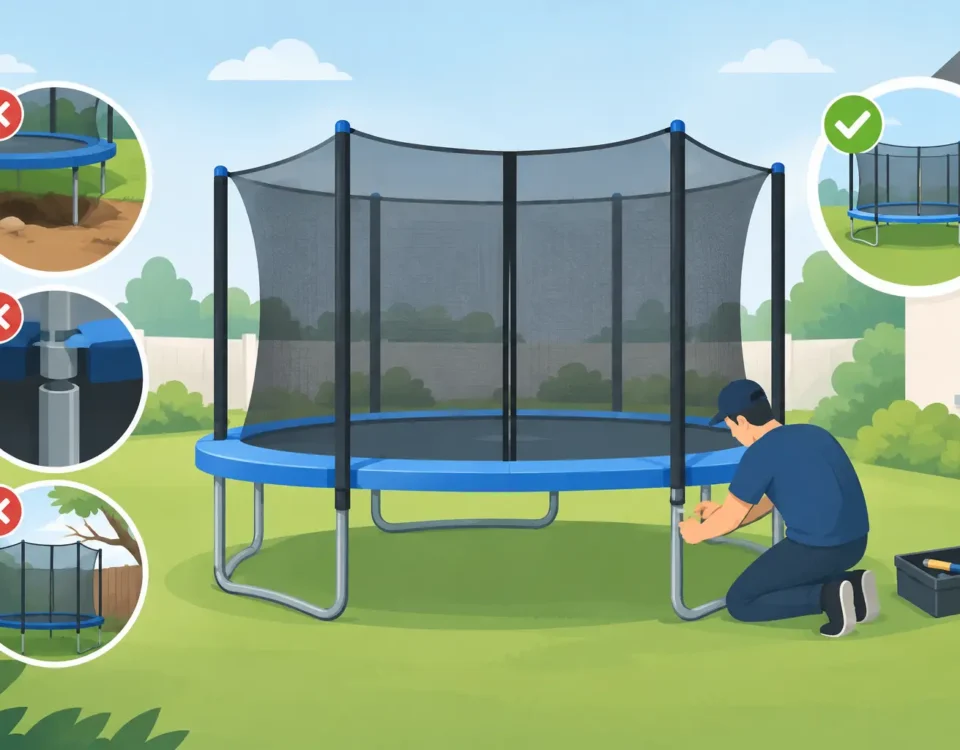
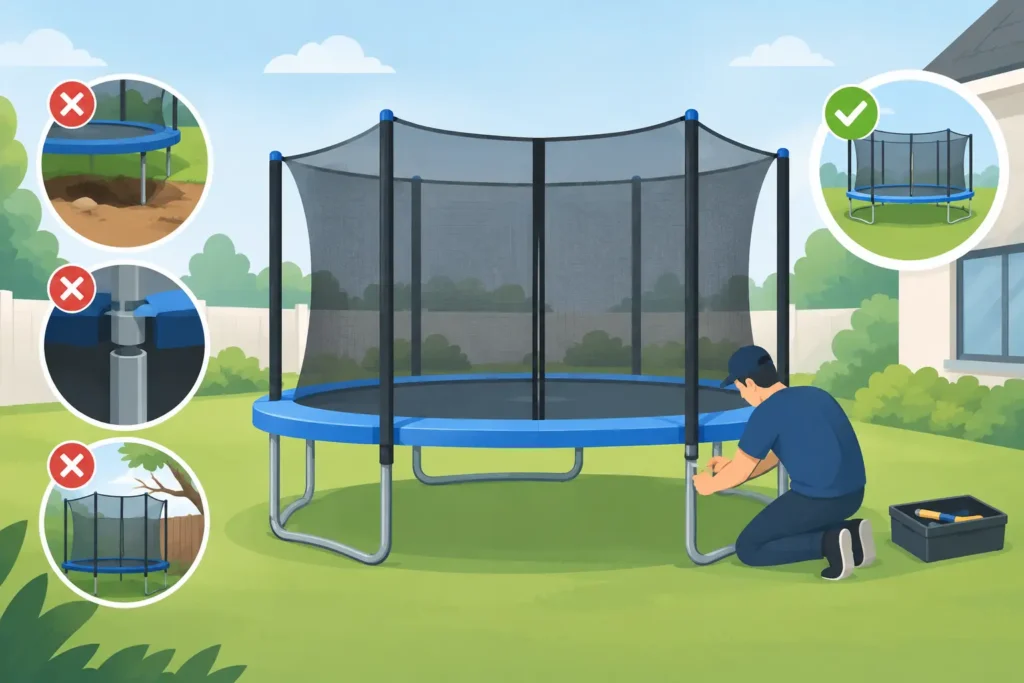
Quality matters here. A premium enclosure should be built to work with the trampoline frame rather than feel like an afterthought. Look for strong, stable upright supports; durable netting; protected poles; secure entry points; and materials made to hold up to regular outdoor use. Galvanized, rust-resistant steel is especially valuable for the structural parts of an in-ground system exposed to changing weather.
For parents, the enclosure also makes it easier to enforce a simple rule: one jumper at a time. A net does not make multiple jumpers safe, but it gives you a clearly defined space where children can take turns and focus on controlled play.
A better fit for younger children
Young children are still learning balance, body control, and spatial awareness. They may drift toward the edge while bouncing, stop suddenly, or turn around without realizing where they are on the mat. An enclosure provides helpful forgiveness during that learning curve.
If your household includes children under 10, frequent neighborhood guests, or kids with a wide range of ages, a net is generally the more responsible option. The additional cost is small compared with the long-term value of a premium in-ground trampoline system and the protection it provides through years of use.
More confidence for active teens
Teenagers may be more coordinated, but they also tend to jump higher and use the trampoline more aggressively. They may practice basketball-style jumps, fitness routines, or basic aerial skills. An enclosure helps contain that energy without changing the open, low-profile look that makes an in-ground trampoline such a natural addition to a backyard.
The goal is not to encourage risky stunts. It is to create a dependable space for active outdoor movement, whether your teen is bouncing after school, training for a sport, or spending time outside with friends.
When Would a No-Net Trampoline Make Sense?
A trampoline without a net can have a clean, open appearance, particularly when it is installed in-ground. Some homeowners prefer the uninterrupted sightlines, and experienced adult users may feel that an open trampoline better suits a controlled fitness or training routine.
That said, a no-net setup is a specialized choice, not the standard recommendation for a family yard. It is best considered only when the trampoline will be used by mature, highly coordinated jumpers who understand the limits of the equipment and follow strict rules. Consistent adult supervision is still essential when children are present.
A net-free trampoline also needs generous clear space around it. There should be no patio furniture, retaining walls, trees, play equipment, hardscape edges, or other hazards close to the perimeter. The surrounding landscape must be designed with the possibility of an off-trampoline landing in mind.
If you are buying one trampoline for the whole household, think beyond today’s most experienced jumper. Your children may invite friends over. Younger cousins may visit. The family may grow. A safety enclosure gives your backyard more flexibility and makes the equipment easier for more people to enjoy responsibly.
In-Ground Trampolines Still Need Edge Protection
It is easy to assume that an in-ground trampoline does not need a net because it sits close to lawn level. In-ground installation does reduce the height of a potential fall compared with many above-ground models, and it creates an attractive, integrated landscape design. But lower is not the same as risk-free.
The edge of the trampoline remains a transition point between the jumping mat, pads, frame, and surrounding ground. Proper padding and a correctly fitted enclosure help protect that area. They also help keep jumpers centered on the mat, where the bounce is designed to perform best.
A professionally planned in-ground installation should account for more than the trampoline’s diameter. It needs adequate excavation, drainage, ventilation, access for maintenance, and room around the system. Add the enclosure to that plan from the beginning so the finished trampoline looks intentional and functions as one complete safety system.
Choosing the Right Net for Your Trampoline Size and Shape
The enclosure must match the trampoline exactly. A round 10-foot in-ground trampoline needs a different net configuration than a 12-foot or 14-foot model, while rectangular systems such as 10-foot by 6-foot and 11-foot by 8-foot trampolines require shape-specific support and netting.
Do not treat an enclosure as a universal accessory. A poorly fitted net can sag, leave gaps, interfere with padding, or fail to provide dependable support at the edge. Choose a system designed for your model and install it according to the manufacturer’s instructions.
Your family size also affects the right trampoline choice. A compact round model can be an excellent fit for one child or a smaller yard. A larger round trampoline provides more jumping room, while a rectangular layout may use narrow or defined yard space more efficiently. In every case, make sure there is enough room for the enclosure and safe access around it.
Make the Net Part of Your Safety Routine
A safety net works best when it is inspected regularly. Before a busy weekend or a playdate, take a quick look at the enclosure. Check that poles are stable, netting is free from holes, attachment points are secure, and the entry closes fully. Also inspect the frame, springs or rods, mat, and protective pads.
Weather protection helps preserve the investment. Remove snow buildup when appropriate, secure or store accessories during severe storms, and use a properly fitted weather cover when the trampoline is not in use for extended periods. Commercial-grade materials and galvanized steel are built for durability, but consistent care helps them deliver their full service life.
Set family rules early and repeat them often. One person jumps at a time. No flips unless the jumper has appropriate training and supervision. Keep food, balls, toys, and pets off the mat. Close the enclosure entrance after every use. These simple habits make the net more effective and help children understand that a trampoline is exciting equipment, not an unsupervised free-for-all.
The Smart Choice for Most Backyards
For the great majority of homeowners, the answer to trampoline net versus no net is straightforward: choose the net. It protects the edge of the jumping area, supports safer everyday play, and makes a premium in-ground trampoline a more practical choice for children, teens, visiting friends, and active adults.
A no-net design can suit a limited number of carefully controlled situations, but it asks more of the user, the landscape, and the supervision plan. A quality enclosure gives your family a stronger foundation for outdoor exercise, laughter, and the kind of backyard memories that keep everyone coming back outside. When you are ready to plan your space, choose the size, shape, and safety system that will serve your family well from the very first jump.